Friday, 17 May 2013

Skippin' and Chick'n

We had two special events today!

 Payton's father brought in some chicks his family is raising.
 We had chickens, quails, a pheasant and a turkey. Which is which?
 The kids had some great questions:
"Which one is hte turkey?"
Where did you find those?"
"I wonder if they turn into chickens?"
"I wonder if they live in a bird house?"
"Can you make them fly?"
I'm naming this one Baby Sprinkles!
 They had some great observations too:

"I think they can fly away."
"One has a pink beak and one have a yellow beak."
"They're having a fight!"
"He has sharp nails!"
"They cuddle together- that's how they keep warm."
"Did you know the turkey has longer legs?"

 The visit inspired some art and writing too:

Later in the day, Jump Rope for Heart was awesome! We had a perfect day for it.


Thanks everyone for your donations! Have a wonderful long weekend.

Friday, 10 May 2013

Chirp!

It started with a question: 
What do you think will live in here?

We were hoping to spark a new inquiry but asking the children to wonder.

 Later that day, with the new residents in place in their cage, the children tried to guess what was under the towel. Because they are seasoned scientists, they listened to hear what was in there.
"I hear scratching." - Cameron Hu
 Once we did a lot of wondering and questioning and the inquiry juices were flowing, we revealed our new class pets...crickets!

 The questions started flying within moments.
Why do they have that cardboard? Do they eat it?
What are they?
What's that thing on their heads?
How many legs do they have?
How many are there?
Which ones are boys and which ones are girls?
What can we name them?

Some students also started writing down their questions:
"Why do the antenna move?"
 Our little scientists were excited about exploring our new roommates.
 Many students decided their enclosure wasn't exciting enough, so they attached elastic bands so they could swing. Later, during trips to the park, we collected sticks and rocks that made a more natural playground for the crickets.

Inquiries are how we drive the literacy curriculum, and a lot of oral language and writing happen naturally. When students are interested in what they are learning, they are motivated to communicate their new knowledge. Here, Faith has made a sign asking people not to knock on the cage.
 The questions and observations of the students are displayed beside the cage.

The children are conducting experiments to determine what the crickets like to eat. We've been feeding them lunch scraps and keeping track of what they seem to enjoy.


 As the crickets are dying, we're taking out the dead ones for the children to dissect. While everyone is sad when one dies, it's a learning opportunity. It's a chance for them to examine the crickets up close, and they discovered how many legs they have, how many eyes, and can see first hand the oviduct spike that identifies the females. The kids also discovered that if you leave something dead in a closed container on Friday, you get a smelly surprise on Monday!


Recently, the crickets have started to chirp, and it's exciting to see the interest renewed in our pets. They are eager to learn why and how the chirps happen.

The learning continues!

Wednesday, 8 May 2013

C'mon in!

For an assignment in the course I'm currently taking, we are creating  digital stories about the centres in our classrooms. I thought that maybe the parents in our class would be interested in seeing where all the action happens! It's hard for many parents to volunteer in the class, so for those who can't, here's a bit of a tour!

Art Studio
In the art studio, we have lots of storage for loose parts and artistic tools.  On top of the shelving we have an area to document the learning happening in the studio. At this centre, children focus on the artistic process and on honouring thier creativity. They work on fine motor and self-regulation skills.
Behind the shelf (not shown) is the water table, where sensory play happens. A lot of mathematical thinking happens here, as well as oral language and social skills.
 Writing Workshop
This is a popular centre where children draw, create, and write. They love making books using pictures from magazines especially. At this centre, they not only practice writing skills, but also sorting by using the crayon organizer in the centre of the table.
 Science Centre
While our inquiries are distributed throughout the room, this is where we store scientific tools like magnifying glasses and clipboards. We also have baskets of natural loose parts, such as seashells, rocks, and bug specimens for the children to explore, sort, and create with. Today we have a tray containing the roots and bulbs from our tulip exploration.
 Quiet Corner
On this side of the quiet corner, we have our reading couch and our listening centre (not shown-temporarily out of order) as well as the computer. The children have created a sign-up list for the computer to keep it from getting crowded and to help them wait their turns.

On the other end of the quiet corner, we have a book display, puzzles, sewing baskets, and our cricket cage. The children use this area to interact with books, to engage in the scientific process, and to work on fine motor and sequencing skills.
 Rocking Chair
This is where we hold morning meetings and teach our mini-lessons to the whole class. We have a sharing basket for children to submit items they want to share with the whole class after play time. At this centre, they learn the self-regulation required to sit politely for short periods of time and they learn how to be good listeners and public speakers. The rocking chair is also used at play time to play teacher, so it is used for dramatic play as well. Here, we also dance and sing together.
 Construction Carpet
Here we have shelves and baskets filled with building materials such as blocks, lego,  and found materials, as well as props such as cars and dinosaurs. Children learn all sorts of skills here, such as spatial skills, gross motor, co-operation, dramatic play, and even basic physics. We've talked a lot about gravity, balance, and force.
 Cubbies
While not a traditional learning centre, a lot of learning happens here! The children learn to keep track of their belongings, to dress themselves, to respect the space of others and to co-operate with each other.
 Dramatic Play
This centre chages fairly frequently. It's been a fire house, a doctors' office, a  restaurant, and a house. Right now the children have created "Letterland", where they can role play their favourite characters.
 Math Centre
We store lots of loose parts here, such as buttons, stones, jewels, and sticks. The children use these for building, sorting, patterning, counting, and creating art. The most popular toy here are the snap cubes, which the children use to create spinning toys. Lots of mathematical thinking happens here, as does oral language and social skills.

Thanks for visiting our room! If you'd like to see it in person, drop Krista or Katy a line and we'll set up a visit for you.

Friday, 3 May 2013

Questions about tulips

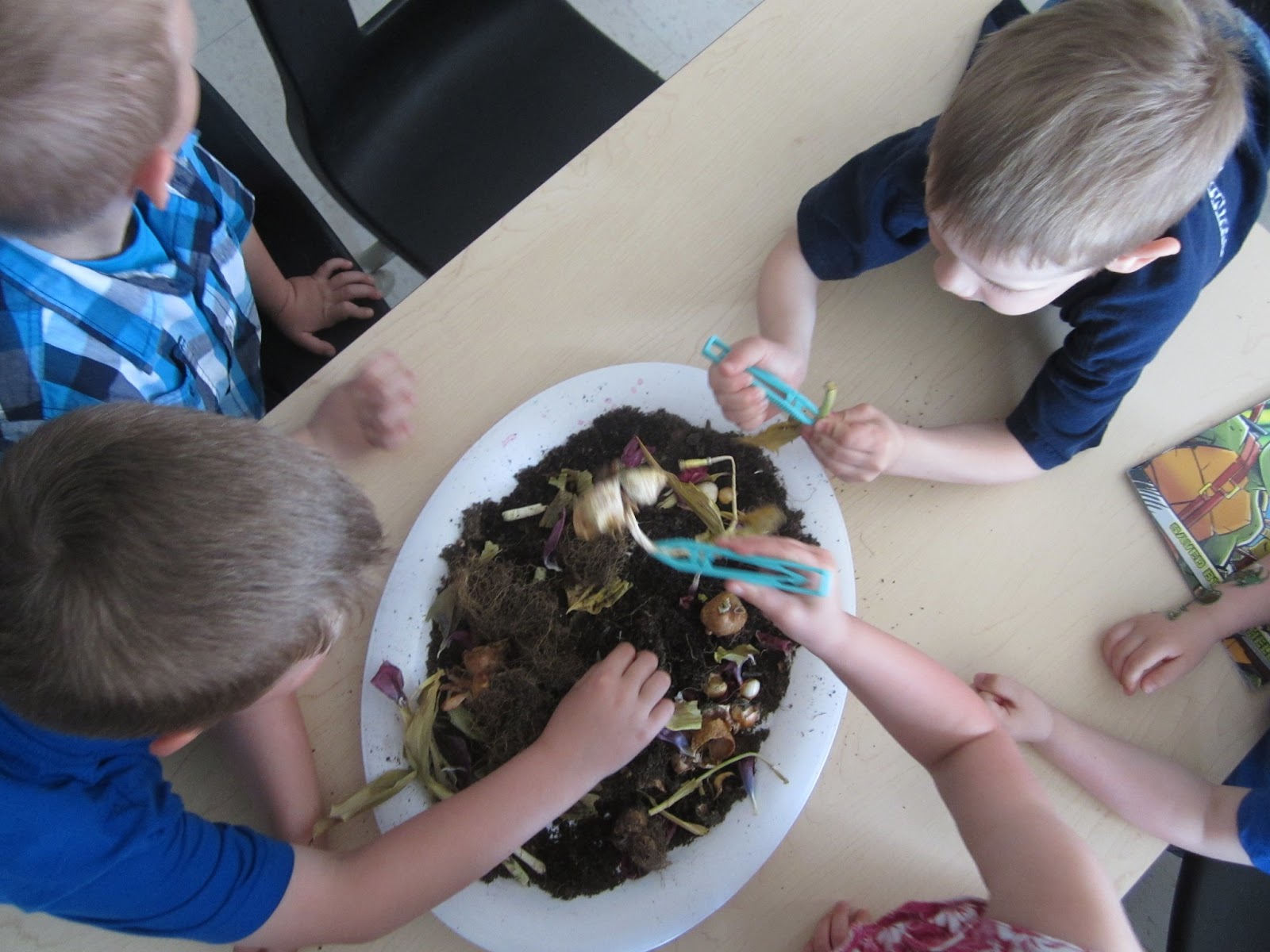
Ms Ramsay gave us a pot of tulips just before she left our class. Now that they have faded, we decided to inquire about what was inside the pot. The students we active in the inquiry process - wondering, exploring, planning, and observing. With this post, they are engaging in the last step in the process: sharing ideas. 

I'm so pleased to notice a real richness to their questions; it highlights how much they have grown as learners since September. I've included some of the questions they asked at the end of the post, and also some quotations under the photos.

~This post is brought to you by Aidan, Liam, Sara, Owen, Rachel, Caitlyn, Cameron Ha. and Keegan. They picked the pictures and helped Miss Russell type the words.~

The tulips got are dried and wrinkly. The petals turned purple instead of pink. We were wondering what was under the tulips. Why didn't the stems come out?
 Guesses were:  roots, a big seed, water was sucking on to it, the soil.
We lifted it up and saw grass sticking out of the bottom holes. It looked like hair.
 Look! It was grass and soil. But then we saw something else inside. So we decided to open it up.
It's called roots.

Oh my gosh! Look what's inside!
 We found roots, big seeds called bulbs and dirt.
Those are the biggest seeds ever! The stem is coming right out.
 They were using gloves to pick up dirt and seeds.

 We were grabbing the seeds with the tweezers. When we were grabbing it, we squeezed it hard and squirted in my face! I squeezed harder and harder and it exploded into little pieces! I think that the water goes into the soil, then into the white things and it makes it goes up to the flowers. The sun shines on it and dries it so we have to water it again. That's why it is wet and slimy.
I squeezed it and it squirted! Right on my face! Ahhh!
 It looks like an onion.
 The flower is growing out of it. The roots come out the bottom.
 When we opened one up it looks like eggs inside. And it has brown skin.
What's inside this? Oh, it's the baby seeds. Now we know!

 In the dirt we found: diamond crystals, a fly, grass, skin and leaves.
 I'm trying to see what was in the bulb.
 It was cool inside the bulb.
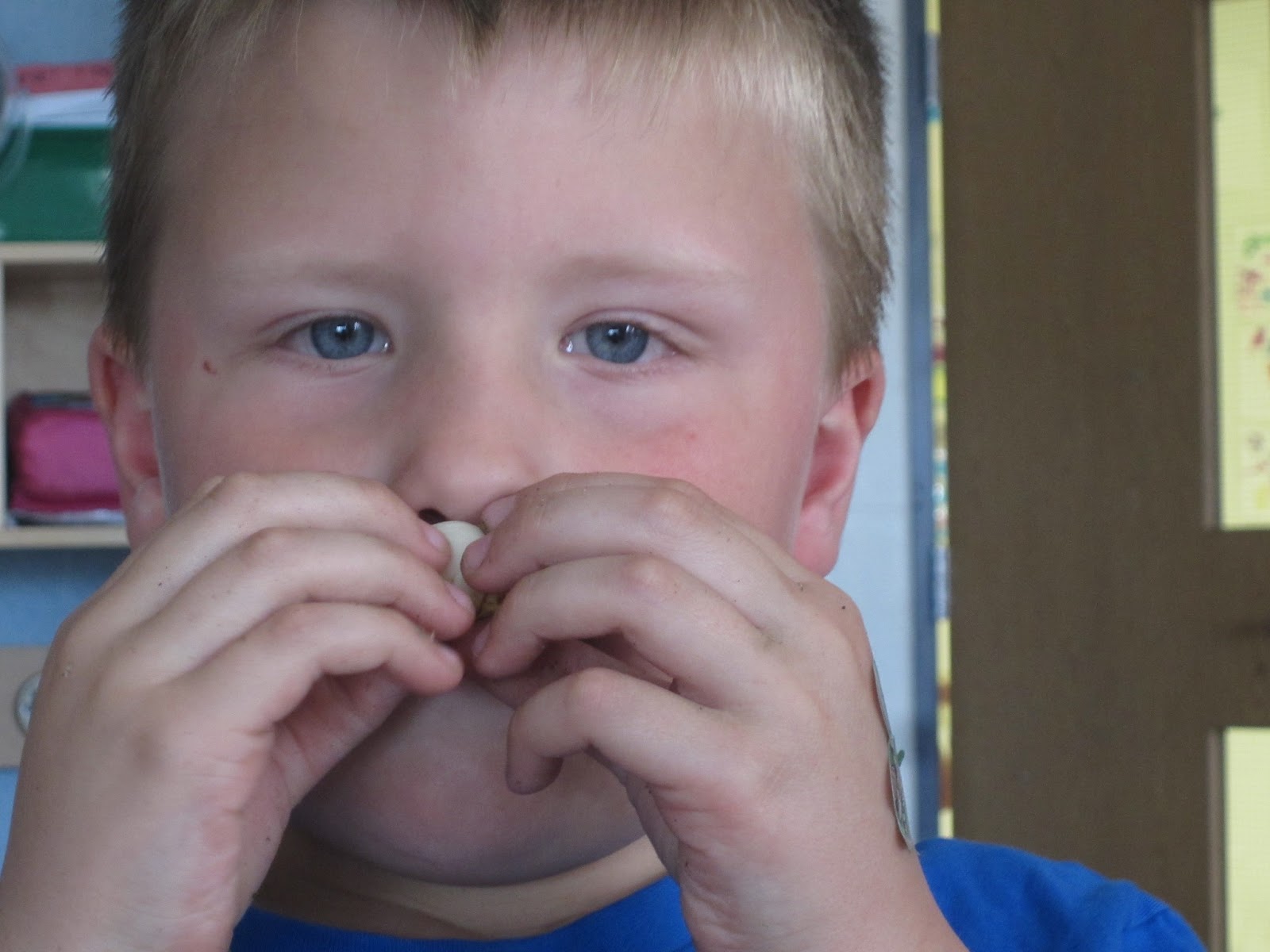
 I smelled it. It smelled good!
Smell it! It smells like mint a bit. I smelled a flower at a store once. It smelled like that. It reminds me of it.
Check out all these questions that were flying:

Why do you think the tulip petals are soft?
Why is this part of the petal white?
Why is this slimy?
What does it smell like?
Why does it look like an onion?
What's all that grassy stuff? (roots)
What is holding the stem in the dirt?
Why does the skin feel like paper?

It's not always getting the answer that's important - sometimes just asking the right questions is where the learning happens.